Science in the Age of Artificial Intelligence
Reflecting on the Max Planck Schools Day 2025
Each fall, PhD candidates, Fellows, representatives from partner organizations, and, most importantly, the new cohorts of the three Max Planck Schools—Matter to Life, Photonics, and Cognition—gather at the Harnack House in Berlin to celebrate the annual Max Planck Schools Day. This year, the event took place on October 9 and focused on fostering personal exchanges, gaining fresh insights, and discussing the future of science in the age of artificial intelligence (AI).
By now, the Max Planck Schools Day has become an established annual event for the three schools, offering PhD candidates the opportunity to share ideas, discuss their research progress, celebrate collective achievements, and expand their networks within the Schools’ community. This year’s leading theme ‘Science in the Age of AI – Transformation, Responsibility, and Opportunity’ was a highly relevant topic impacting all scientific disciplines.
Inspiring Insights at the Outset


In his opening speech, Ferdi Schüth, member of the Max Planck Schools Steering Committee, highlighted the importance of interdisciplinary networking. He emphasized that success in the doctoral program depends on challenging established boundaries, taking responsibility, and constantly striving for knowledge and truth. Schüth noted that the Max Planck Schools are committed to preparing their PhD candidates for future challenges, equipping them with long-term innovation and research competencies.
Furthermore he also encouraged the audience to look beyond their usual horizons, explore new perspectives, and pursue innovative ideas. He reminded the PhD candidates of the fundamental motivation behind their research: the desire to make a meaningful and sustainable contribution to the well-being of humanity.
From Industry to Basic Research


A highlight of the day was the talk by Karin Jacobs, Fellow of the Max Planck School Matter to Life and experimental physicist at Saarland University. In her very personal reflection on her career, she shared her journey between industry and academia: "My heart beats more for knowledge-oriented research. I want to be free in what I want to research, I want to do truly curiosity-driven research, which is why I went back to science.”
From her time at Bayer to her return to academic research, Jacobs emphasized the importance of following one’s curiosity. She shared that mistakes are an inevitable part of the scientific process and highlighted how crucial it is to recognize them, learn from them, and share the insights gained. She concluded her presentation with an inspiring message to the doctoral candidates in the audience: "Decide what you are up to. Find your path – there is no single way to happiness in science, that's for sure”.
Interdisciplinary Aspects of Artificial Intelligence

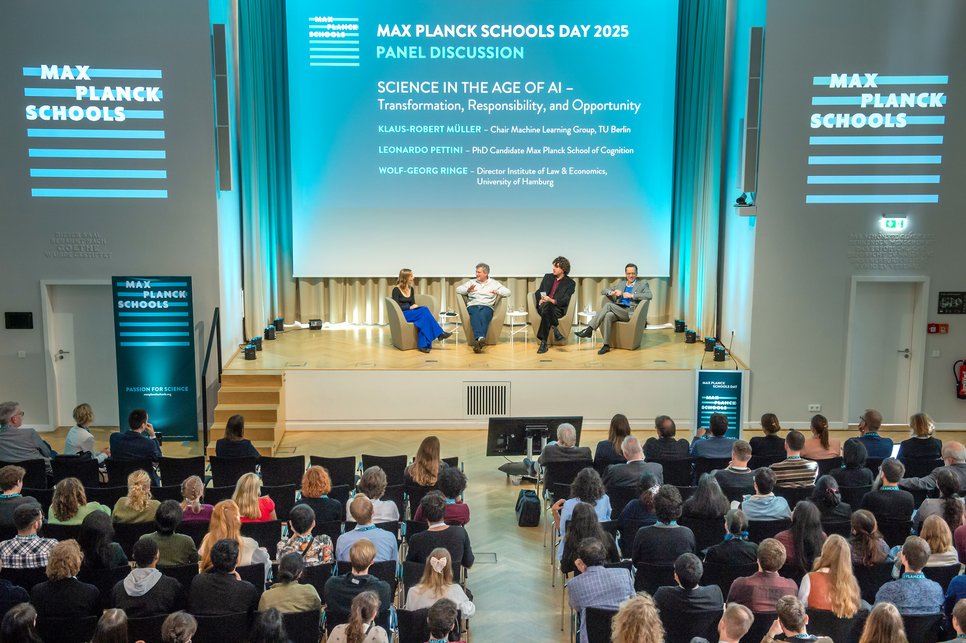
The afternoon featured a panel discussion on this year’s leading theme with experts Wolf-Georg Ringe, Klaus-Robert Müller and Leonardo Pettini (MPS Cognition). Moderated by science journalist Sophie Stigler, the panelists explored the opportunities and challenges of integrating artificial intelligence into research and society from a scientific perspective. The discussion underlined the importance of interdisciplinary collaboration in developing and crafting responsible solutions for the use of AI.
During the subsequent workshop sessions, participants were invited to engage in dialogue-oriented formats, allowing them to deepen their own perspectives on key issues alongside two of the panelists. In the workshop 'Regulation of AI and the role of governments', led by Wolf-Georg Ringe, participants discussed how researchers and other stakeholders can actively contribute to regulatory frameworks. One of the focal points was whether AI-assisted facial recognition should be used in public transport to identify violations. The second workshop, 'The Role of AI in Research', led by Klaus-Robert Müller, provided PhD candidates a platform to share their experiences with AI in their own research. The discussion centered around how AI can be responsibly integrated into the educational and research landscapes, and what strategies are needed to ensure ethical and sustainable development. The results of the two workshops were then shared with the audience and sparked further discussions.


Science Talks – Insights into the Max Planck Schools
Another highlight of the program was the annual ‘Science Talks’, where three selected candidates presented their research projects, showcasing the interdisciplinary diversity of the Max Planck Schools.
Anastassiya Schramm (Alumna of the MPS Matter to Life) developed a light-controlled platform for the triggered release of active substances. Using vesicles functionalized with gold nanorods that respond to near-infrared light, her research offers new approaches for future therapeutics, diagnostics and intelligent biomedical systems. The effects of sexual abuse in early childhood on the structure and plasticity of the somatosensory system are the focus of Yuliya Kovalchuk's (MPS Cognition) research, which she presented as part of the Science Talks. Her goal is to gain a deeper understanding of the long-term effects of such traumatic experiences on the brain.

Dr. Anastassiya Schramm, graduated at the Department of Cellular Biophysics and Engineering at Max Planck Institute for Medical Research in Heidelberg, where she conducted her research under the supervision of Professor Joachim Spatz.

Yuliya Kovalchuk, PhD candidate at Charité university hospital Berlin, impressed the audience with insights into her work on the neurological basis of sexuality, neuroendocrine influences on cognition, and sex-specific fMRI research.

Daniele Ronchetti has been pursuing his doctorate at research center DESY at the university of Hamburg since September 2021 and enthusiastically presented his results at the Max Planck Schools Day.
Daniele Ronchetti (MPS Photonics) is working on developing X-ray scattering under extreme conditions. At the European XFEL (European X-ray Free-Electron Laser Facility), he manipulates the electronic states of atoms through photoionisation to improve atomic scattering processes and gain new insights into the structure of matter. The presentations clearly demonstrated the passion and curiosity that the young scientists bring to their work and research.
Concluding Remarks


In his closing speech Walter Rosenthal, President of the German Rectors’ Conference (HRK) and Co-Chair of the Max Planck Schools Steering Committee, encouraged the PhD candidates to embrace the challenges ahead as they continue on their academic journeys. He thanked the PhD organization team and wished everyone a pleasant conclusion of the event.
Once again, the day wrapped up on a high note with impressive musical performances by the MPSP band, the Matter to Life band Ciriniri, and the Matter to Life DJ Andrey. Reflecting on the event, PhD candidate Daniele Ronchetti aptly summed up the experience: "An amazing experience on a wonderful day. Although we come from different academic backgrounds, we share a passion for science, and it was this spirit that was clearly evident in this special atmosphere.”


The positive feedback from participants confirms that the Max Planck Schools Day is much more than just a scientific conference. The event provides a platform for lively exchanges, interdisciplinary thinking, and meaningful personal encounters.
We are already looking forward to the next Max Planck Schools Day in October 2026!

‘It's my 4th time at the Max Planck Schools Day, so I knew what to expect. It was great as always. I really liked the food, because I'm vegan. And the Harnack house is amazing - there's plenty of space, couches, a huge dining room, a garden - everything you need.’ - Karem Alim, MPS Matter to Life

‘The AI topic reflected exactly what my friends and I are thinking. We're all dealing with these questions. The discussion was very helpful, about how important transparency is and being honest in AI. I liked the quote "Humans are lazy". The conference reflected what is happening in the world right now.’ - Samuel Novák, MPS Matter to Life

‘I didn't like the AI panel discussion. There could have been more blunt questions about the future, like the loss of jobs or issues of education. No one can know the answers yet. But it would have been great to hear the discussion.’- Anna Mukhina, MPS Matter to Life

‘I was pleasantly surprised by how well the candidates networked across schools and exchanged ideas. I especially enjoyed the science talks. As for the panel discussion, when I think of AI, I typically associate it with the natural sciences, so I appreciated hearing an expert discuss its economic aspects as well. It would have been great to also address the energy consumption of AI.’ - Julia Ricken, Scientific Coordinator MPS Matter to Life

‘My fellow PhD students and me all thought, the science talks were like TED-Talks. I felt totally engrossed in them. I never covered any of these topics in my life. The analogy of Lego was great!’ - Conrad Blau, MPS Cognition


